
OpenClaw: The Autonomous Agent Revolutionizing CI/CD Pipelines – A Deep Dive
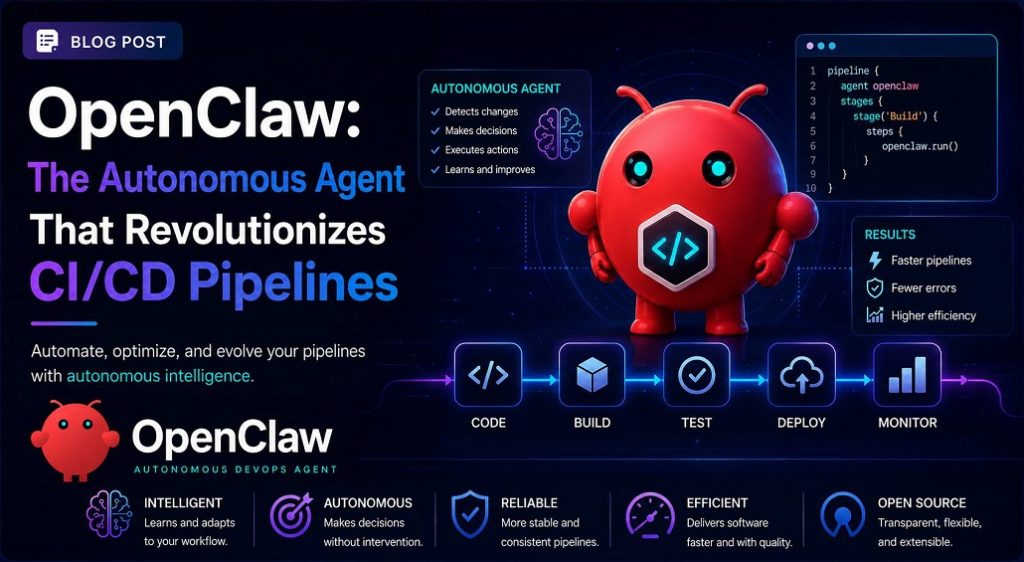
At OpsAnalytics, we are convinced that the next major disruption in DevOps will not come from a new orchestration tool, but from intelligent agents capable of operating within the software lifecycle with unprecedented levels of autonomy. OpenClaw is the open-source project making that vision a reality. In this article, we outline its foundations, dive deep into its internal architecture, show real configuration and code snippets, rigorously analyze when it truly adds value, and illustrate it with a real-world use case in the insurance sector, one of the most demanding industries in terms of compliance and business continuity.
1. What is OpenClaw? Reminder and Key Nuances
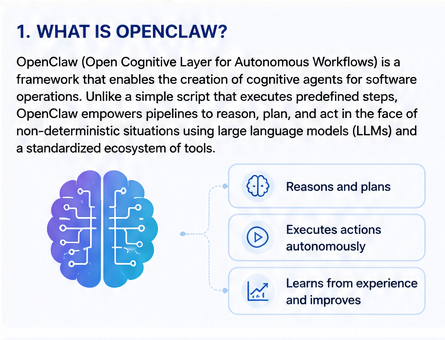
OpenClaw (Open Cognitive Layer for Autonomous Workflows) is a framework that enables the construction of cognitive agents for software operations. Unlike a simple script that executes predefined steps, OpenClaw equips pipelines with the ability to reason, plan, and act in the face of non-deterministic situations, using Large Language Models (LLMs) as the brain and an ecosystem of standardized tools.
But the true revolution is not in the LLM; it is in the control layer that surrounds it. OpenClaw introduces programmable guardrails, long-term memory, and a multi-agent architecture that allows for the separation of responsibilities (diagnosis, remediation, reporting) while always keeping a human in the loop for critical decisions.
2. Deep Architecture: Beyond “LLM + Tools”
When implemented in enterprise environments, OpenClaw deploys a much richer anatomy than meets the eye. We break down the key components an engineer configures in real-world projects.
2.1. Multi-Layer Brain
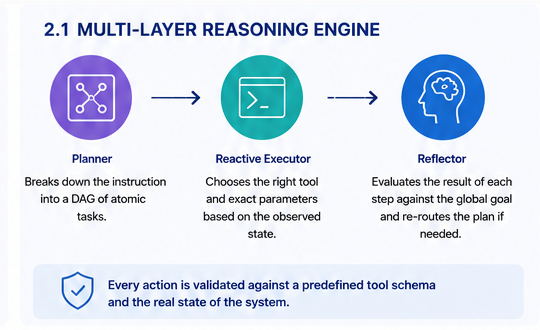
The agent is not a single prompt. It uses a Reasoning Engine system with three chained reasoning modes:
- Planner: Decomposes the instruction into a DAG (Directed Acyclic Graph) of atomic tasks.
- Reactive Executor: Decides the exact tool and parameters based on the observed state.
- Reflexive: Evaluates the result of each step against the global goal and, if necessary, reroutes the plan.
This design drastically reduces hallucinations because every action is validated against a predefined tool schema and the actual state of the system.
2.2. Augmented Memory System (RAG)
OpenClaw incorporates a vector knowledge base that indexes:
- Historical deployment logs.
- Runbooks and internal documentation.
- Previous incident tickets and their resolutions.
- Relevant metrics and dashboards.
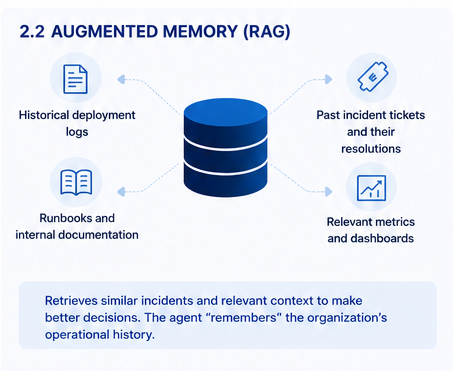
When the agent diagnoses a failure, it doesn’t just look at the current log; it retrieves the five most similar incidents (using embeddings) and uses that context to refine its reasoning. This turns the agent into a team member that “remembers” the organization’s operational history.
2.3. Guardrails and Security Layer (Policy Layer)
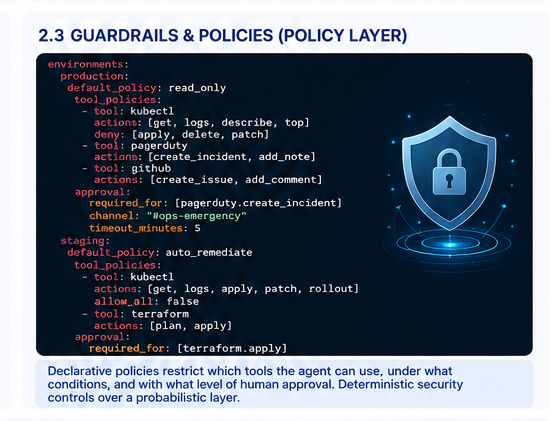
This is where one of OpsAnalytics’ greatest contributions lies in every deployment. We define declarative policies that restrict which tools the agent can use, under what conditions, and with what level of human approval. An example we use with clients:
yaml
# openclaw-policies.yaml
environments:
production:
default_policy: read_only
tool_policies:
– tool: kubectl
actions: [get, logs, describe, top]
deny: [apply, delete, patch]
– tool: pagerduty
actions: [create_incident, add_note]
– tool: github
actions: [create_issue, add_comment]
approval: required_for:[pagerduty.create_incident]
channel: “#ops-emergency”
timeout_minutes: 5
staging:
default_policy: auto_remediate
tool_policies:
– tool: kubectl
actions: [get, logs, apply, patch, rollout]
allow_all: false
– tool: terraform
actions: [plan, apply]
approval: required_for: [terraform.apply]
This way, even if the LLM “decides” to execute a dangerous command, the policy layer blocks it at the execution level, not the prompt level. It is a deterministic security control over a probabilistic layer.
2.4. Multi-Agency
For complex flows, OpenClaw allows decomposing the work into specialized agents: a Diagnostic Agent, a Remediator Agent, and a Reporter Agent. They communicate through an internal message bus that maintains shared context. This division of responsibilities increases precision and facilitates auditing.

3. Automation Capabilities That Excite (and Concrete Examples)
Beyond general scenarios, we share capabilities we are already implementing in the field:

- Database self-healing during failed migrations: In an insurance company, an agent detected a deadlock during a PostgreSQL schema migration. It analyzed the locked table, compared it with the migration branch, identified a non-concurrent index, and in staging, applied the fix and re-executed the migration. In production, it generated the corrective script and submitted it as a Pull Request, leaving the final decision to the DBA.
- Drift detection in Infrastructure as Code (IaC): The agent scans cloud resources every hour against the state declared in Terraform. If it finds deviations (e.g., a security group manually opened by an operator), it can automatically revert it in development environments and notify with an impact report for production.
- Test coverage analysis and recommendations: Upon a test suite failure, the agent can analyze the commit diff, identify which modules lack coverage for the changes made, and suggest creating new test cases, including boilerplate code in the project’s language.
- Automated compliance pipeline: For every deployment, the agent verifies that all required evidence (vulnerability scanning, peer review, change approval) is present in the release management tool. If anything is missing, it blocks the pipeline and opens a ticket with the exact checklist to complete.
4. Implementation Snippets in a Real Pipeline
We revisit the previous GitHub Actions example and enrich it with guardrails and memory. This pipeline deploys to an EKS cluster and integrates OpenClaw for diagnosis and remediation, with human approval in production.
yaml
name: Deploy with cognitive self-healing
on:
push:
branches: [main, release/*]
jobs:
deploy-and-heal:
runs-on: ubuntu-latest
environment: ${{ github.ref_name == ‘main’ && ‘production’ || ‘staging’ }}
steps:
– uses: actions/checkout@v4
– name: Deploy to Kubernetes
id: deploy
run: kubectl apply -f k8s/overlays/${{ github.ref_name }}/
continue-on-error: true
– name: OpenClaw analyze failure
if: failure()
uses: openclaw/agent-action@v2
with:
instruction: |
The deployment of commit ${{ github.sha }} in the ${{ github.ref_name }} environment has failed.
Connect to the cluster, extract logs from pods in CrashLoopBackOff or ImagePullBackOff.
Cross-reference this information with the latest changes in Docker images and configurations.
If you find a clear root cause, prepare to suggest remediation.
config: .openclaw/agent-config.yaml
env: ${{ github.ref_name }}
memory-store: s3://openclaw-memory-bucket/team-alpha/
env:
OPENCLAW_POLICIES: ${{ secrets.OPENCLAW_POLICIES }}
KUBECONFIG: ${{ secrets.KUBECONFIG }}
LLM_API_KEY: ${{ secrets.LLM_API_KEY }}
The .openclaw/agent-config.yaml file contains references to the policies we saw earlier. Note the use of memory-store in S3, where the agent persists learnings from each incident for future executions.
For teams preferring GitLab CI, the mechanism is analogous, with a job that triggers upon failures and uses the agent image to orchestrate the response.
5. Where It Fits (and Where It Doesn’t): A Maturity Analysis
At OpsAnalytics, we have developed a maturity model to guide companies in adopting autonomous agents. We summarize it here:
| Maturity Level | Characteristics | Is OpenClaw Viable? |
| Level 1: Manual | Manual deployments, no IaC, scattered logs | ❌ No. The agent lacks structured context. |
| Level 2: Basic Automated | Standard CI/CD, deterministic scripts, low observability | Only in very narrow tasks with tight supervision. |
| Level 3: Solid Observability | Centralized dashboards, aggregated logs, defined alerts | ✅ Yes, for diagnosing and remediating common failures with conservative policies. |
| Level 4: Infrastructure as Code | Versioned IaC, ephemeral environments, reliable pipelines | ✅✅ High autonomy in staging, and auto-remediation with approval in prod. |
| Level 5: GitOps & Continuous Compliance | All changes via Git, policies as code, automated auditing | ✅✅✅ Agent capable of operating in production under strict guardrails and selective approval. |
It does not fit yet when:
- The organization has not resolved the cultural issue: “the agent is going to replace my job.” We address this with transparency and design centered on augmenting capabilities, not eliminating roles.
- There are non-automatable external dependencies (e.g., changes requiring manual intervention on an insurance mainframe). In these cases, the agent is limited to preparing documentation and notifying the correct team.
- Data sovereignty requirements prevent logs from leaving a highly restricted VPC. OpenClaw can run completely on-premise with self-hosted models, but this adds infrastructure complexity.
6. Use Case: Insurance Company Modernizes Its Pipelines with OpenClaw
To ground all of the above, we present a real (anonymized) story of a client in the insurance sector. The insurer is a 40-year-old company with over 5 million policyholders and a digital ecosystem composed of 200 microservices, a mix of legacy systems and AWS cloud-native architecture.
6.1. The Challenge
They faced three critical problems:
- Mean Time To Resolution (MTTR) of 4 hours on average, hampered by fragmented logs and dependence on key experts.
- Compliance audit preparation (SOC 2, ISO 27001, local insurance regulations) consuming 3 weeks per quarter, manually gathering evidence of deployments, changes, and approvals.
- A 15% frequency of failed deployments, often due to incorrect configurations in Kubernetes manifests that were only detected in production.
Technology leadership sought a solution that would not add more isolated tools, but rather inject intelligence into existing flows, while meeting the strict security and auditability requirements of the sector.
6.2. Solution Evaluation and Design by OpsAnalytics
After a four-week AI-DevOps maturity test, we determined the insurer was at maturity level 3-4: good observability with ELK and Prometheus, IaC with Terraform, pipelines in Jenkins and GitLab, but with little standardization in incident management and manual compliance.
We designed a solution based on three pillars:
- Diagnosis and remediation agent in staging (autonomous): OpenClaw with full access to logs, kubectl, and terraform. Policy of immediate auto-repair.
- Incident response agent in production (semi-autonomous): Read capabilities, Jira ticket creation, Slack notifications, and drafting post-mortems. Any write action required dual approval from the shift lead and the security officer.
- Continuous compliance agent: Automated verification in every pipeline to ensure all controls were met, blocking deployment if any evidence was missing. This agent integrated with the change management system (ServiceNow) and the vulnerability tool (Snyk).
6.3. Technical Implementation
We used OpenClaw with a Claude 3.5 Sonnet LLM deployed in a private AWS VPC via Bedrock, ensuring that log and configuration data never left the company-controlled cloud. We configured guardrail policies in a Git repository, with mandatory review before any modification.
A snippet of the compliance pipeline (in GitLab CI) illustrates the approach:
yaml
compliance-check:
stage: pre-deploy
image: openclaw-agent:latest
script:
– openclaw execute –instruction “Verify that the release artifact $CI_COMMIT_TAG complies with:
– Vulnerability scan approved in Snyk (high or critical severity blocks).
– Change ticket approved in ServiceNow with associated CRQ.
– Peer review in the merge request with at least 2 approvals.
If everything is OK, generate a summary for the auditor. If something fails, describe exactly what is missing.”
– openclaw report –format pdf –output evidence/compliance-report.pdf
artifacts:
paths:
– evidence/
The agent interacted with the Snyk and ServiceNow APIs using its preconfigured claws. The generated report was stored as an artifact, ready to be presented in audits.
6.4. Quantitative and Qualitative Results
Six months after progressive rollout (first staging, then production with accompaniment), the indicators spoke for themselves:
- 62% reduction in production MTTR (from 240 min to 91 min), thanks to automated diagnosis and correlation with past incidents.
- Failed deployments dropped to 5%, as 73% of configuration errors were automatically detected and corrected in staging.
- Quarterly audit preparation: from 3 weeks to 4 hours. The compliance team went from manually collecting evidence to reviewing and signing agent-generated reports.
- 20% of senior engineers’ time freed up, shifting from firefighting to working on structural system improvements.
- Zero security incidents caused by the agent, thanks to the dual mechanism of guardrails and human approval, auditable with an immutable log in AWS CloudTrail.
But perhaps the greatest impact was cultural: teams went from viewing AI as a threat to treating it as a tireless junior partner, doing the heavy lifting of research while they make strategic decisions.
7. The Role of OpsAnalytics in the Adoption of Autonomous Agents
Stories like the one above do not happen simply by installing a tool. They require expert accompaniment to ensure autonomy is earned without sacrificing control. At OpsAnalytics, we offer a three-phase framework:
- Discover: We evaluate technical and cultural maturity, identify the highest-ROI use cases (typically, MTTR reduction and compliance automation), and define a prioritized backlog.
- Design & Pilot: We design the agent architecture (how many, with what tools, what policies), implement a pilot with a scoped flow, and establish success metrics.
- Scale & Govern: We extend the solution to more teams and environments, create an internal Center of Excellence to manage agent evolution, and ensure continuous governance through periodic reviews of policies and memory.
This approach, combining open-source technology (OpenClaw) with the methodological rigor of a specialized consultancy, is what enables companies in regulated industries like insurance, banking, or healthcare to embrace AI-DevOps without fear.
Conclusion
OpenClaw is ceasing to be a laboratory curiosity and is becoming a real enabler of autonomous and resilient pipelines. As we have detailed, its power does not lie in the language model, but in the engineering that surrounds it: memory, guardrails, multi-agency, and deep integration with the existing DevOps ecosystem. The insurance case study demonstrates that, with the right accompaniment, even the most conservative sectors can achieve compelling results without compromising security or governance.
At OpsAnalytics, we believe the future of IT operations is not a datacenter full of scripts, but a hybrid team where humans and agents collaborate to maintain systems that not only function, but learn, anticipate, and repair themselves. Is your organization ready to take the next step?
Let’s talk. We bring artificial intelligence to the heart of your operations, with the security your business deserves.
Leave a Reply